
Pink Floyd – The Dark Side of the Moon
Pink Floyd and Spatial Sound
Pink Floyd were—alongside the Beatles—among the first rock bands to systematically experiment with advanced studio production and live performance technologies.s Their work extended beyond sound synthesis and tape techniques to include early spatial and immersive approaches to sound diffusion.
As early as 1967, Pink Floyd introduced the Azimuth Coordinator, a custom-built control device that enabled the real-time distribution of audio signals across four loudspeakers using a joystick interface. Originally developed for live performances, the system allowed performers or technicians to manually position sounds within a quadraphonic loudspeaker layout, anticipating later practices in spatial audio performance and diffusion (Brautschek et al., 2018).

The Dark Side of the Moon occupies a special position in the history of spatial music: it is a work of popular music in which spatial organization functions as a compositional and formal parameter rather than as a secondary effect. Spatial thinking is articulated primarily through studio practice, not through a dedicated multichannel format. The album’s spatiality emerges from techniques such as multi-track recording, panning automation, tape loops, sound effects, and controlled reverberation, which together construct a coherent spatial dramaturgy within an otherwise conventional stereo medium.
Quadraphonic LP (SQ)
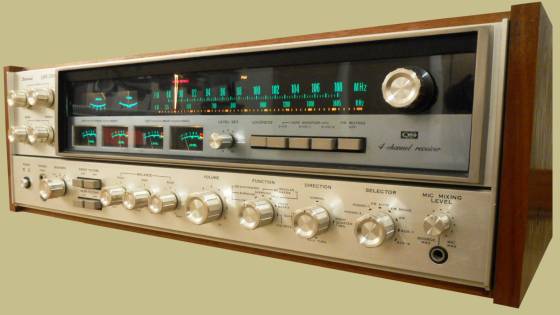
Example of a quadraphonic receiver with integrated SQ decoder (Sansui QRX series, early 1970s).
The Dark Side of the Moon was released in 1973 in a quadraphonic LP version using the SQ matrix system. Four channels were matrix-encoded into two and pressed on a standard vinyl record. Playback was possible on any stereo turntable; decoding to four loudspeakers required an SQ decoder, typically integrated into quadraphonic receivers of the period. Spatial separation was limited and playback-dependent.
Example available hardware in the 1970s:
Quadraphonic receiver with SQ decoder (example): Sansui QRX series
Record player (standard stereo turntable, example): Technics SL-1200
References
2018
- Christoph von Blumröder.
Zur bedeutung der elektronik in karlheinz stockhausens œuvre / the significance of electronics in karlheinz stockhausen's work.
Archiv für Musikwissenschaft, 75(3):166–178, 2018.
[abstract▼] [details] [BibTeX▼] - Tomy Brautschek and Maximilian Haberer.
Echoes of pink floyd: experiencing intimacy through acoustic immersion.
Sound Studies, 4(2):234–237, 2018.
[details] [BibTeX▼]
2015
- Martha Brech and Henrik von Coler.
Aspects of space in Luigi Nono's Prometeo and the use of the Halaphon.
In Martha Brech and Ralph Paland, editors, Compositions for Audible Space, Music and Sound Culture, pages 193–204.
transctript, 2015.
[details] [BibTeX▼]
2011
- John Chowning.
Turenas: the realization of a dream.
In Proceedings of the 17th Journées d\rq Informatique Musicale. 2011.
[details] [BibTeX▼]
2010
- Peter Moormann.
Raum-musik als kontaktzone. stockhausens hymnen bei der weltausstellung in osaka 1970.
Paragrana, 19(2):33–43, 2010.
URL: https://doi.org/10.1524/para.2010.0023, doi:doi:10.1524/para.2010.0023.
[details] [BibTeX▼]
2008
- Marco Böhlandt.
“kontakte” – reflexionen naturwissenschaftlich-technischer innovationsprozesse in der frühen elektronischen musik karlheinz stockhausens (1952–1960).
Berichte zur Wissenschaftsgeschichte, 31(3):226–248, 2008.
[details] [BibTeX▼] - Jonas Braasch, Nils Peters, and Daniel Valente.
A loudspeaker-based projection technique for spatial music applications using virtual microphone control.
Computer Music Journal, 32:55–71, 09 2008.
[details] [BibTeX▼]
1980
- François Potard.
L’acousmonium.
In Pierre Schaeffer, editor, La Musique électroacoustique.
INA–GRM / Buchet-Chastel, Paris, 1980.
[details] [BibTeX▼]