With Symphonie pour un homme seul (1949–1950), Pierre Schaeffer and Pierre Henry
took the first approaches to Musique Concrète to a new level, beyond the scope
of simple studies.
Although not a multichannel composition, the artificial reverberation used in this
piece can be considered a spatial audio production technique.
While artificial reverberation was first used in popular music productions in the 1930s,
Scheffer and Henry used it to create acoustic spaces by shifting between distance and proximity.
Pupitre d'espace
Early acousmatic music is also an origin point for practices of live spatialization.
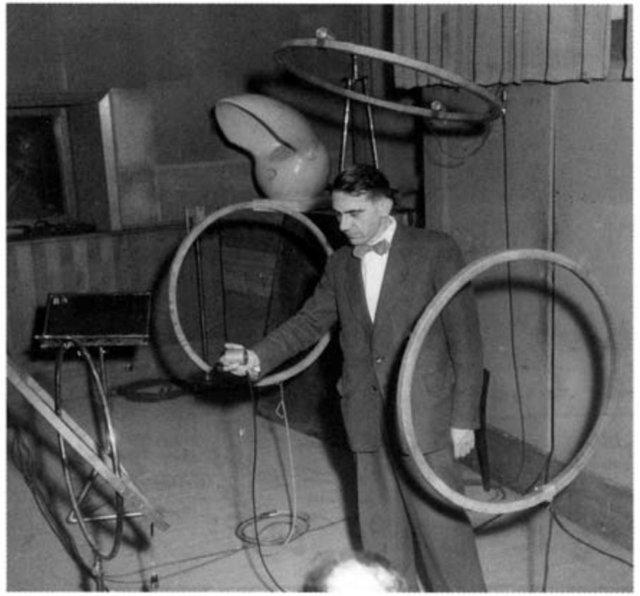
The pupitre d’espace is a performance console developed at the Groupe de Recherches Musicales for the live spatial diffusion of fixed-media electroacoustic works. It provides real-time control over level distribution and routing to a loudspeaker orchestra, allowing prerecorded material to be projected into space during performance. In this context, spatialization is treated as a performative parameter rather than a fixed property of the recording.
Pierre Schaeffer with the 'pupitre d'espace'.
In photographs of Pierre Schaeffer at the pupitre d’espace, the visible rings are rotary potentiometers used as level controls to distribute audio to individual loudspeakers or groups; electrically, they function like faders, but their circular arrangement supports continuous, gestural control (Potard, 1980).
The device is an analog diffusion console, custom-built at the Groupe de Recherches Musicales, based on standard mixing-console electronics—line-level signal paths, resistive control elements, summing buses, and routing matrices.
Composing within the electronic medium, i. e. modifying sound with the help of electroacoustic apparatuses, has been an essential determinating factor in the musical work of Karlheinz Stockhausen, as a spectrum of electronic pieces from Studie I (1953) to Kontakte (1958-60), Mixtur (1964), Hymnen (1966-67), Oktophonie (1990/91), and Cosmic Pulses (2007) documents. The article considers this seemingly well-known fact from a revised musicological perspective. Considerations from a broader compositional-creative context that include both instrumental and vocal components lead to insights into the origins and history of some of Stockhausen's electronic projects that have found less attention until now.
@article{vonblumroeder2018zurbedeutung,
    author = "Blumröder, Christoph von",
    journal = "Archiv für Musikwissenschaft",
    number = "3",
    pages = "166–178",
    publisher = "Franz Steiner Verlag",
    title = "Zur Bedeutung der Elektronik in Karlheinz Stockhausens Œuvre / The Significance of Electronics in Karlheinz Stockhausen's Work",
    volume = "75",
    year = "2018"
}
@incollection{vonColer2015aspects,
    author = "Brech, Martha and von Coler, Henrik",
    editor = "Brech, Martha and Paland, Ralph",
    booktitle = "Compositions for Audible Space",
    pages = "193--204",
    publisher = "transctript",
    series = "{Music and Sound Culture}",
    title = "Aspects of Space in {Luigi Nono's Prometeo} and the use of the {Halaphon}",
    year = "2015"
}
@inproceedings{chowning2011turenas,
    author = "Chowning, John",
    booktitle = "{Proceedings of the 17th Journ{\'e}es d{\rq}Informatique Musicale}",
    location = "Saint-Etienne, France",
    title = "Turenas: The Realization of a Dream",
    year = "2011"
}
@article{moormann2010raum,
    author = "Moormann, Peter",
    doi = "doi:10.1524/para.2010.0023",
    url = "https://doi.org/10.1524/para.2010.0023",
    title = "Raum-Musik als Kontaktzone. Stockhausens Hymnen bei der Weltausstellung in Osaka 1970",
    journal = "Paragrana",
    number = "2",
    volume = "19",
    year = "2010",
    pages = "33--43"
}
@article{braasch2008aloudspeaker,
    author = "Braasch, Jonas and Peters, Nils and Valente, Daniel",
    year = "2008",
    month = "09",
    pages = "55-71",
    title = "A Loudspeaker-Based Projection Technique for Spatial Music Applications Using Virtual Microphone Control",
    volume = "32",
    journal = "Computer Music Journal"
}
1980
François Potard.
L’acousmonium.
In Pierre Schaeffer, editor, La Musique électroacoustique.
INA–GRM / Buchet-Chastel, Paris, 1980. [details]
[BibTeX▼]
@incollection{Potard1980,
    author = "Potard, François",
    editor = "Schaeffer, Pierre",
    title = "L’Acousmonium",
    booktitle = "La Musique électroacoustique",
    publisher = "INA–GRM / Buchet-Chastel",
    year = "1980",
    address = "Paris"
}