
Stockhausen & Elektronische Musik
Kontakte
Stockhausen’s Kontakte (1958–60) can be considered a milestone in the history of multichannel music. The work exists in two versions: one for tape alone, and another for tape with live piano and percussion. For the tape part, Stockhausen employed the Rotationstisch—a mechanical rotation device described below—to generate spatial movement within a quadraphonic loudspeaker setup. Although these movements cannot be fully reproduced in stereo, the passage at 17′00″ contains a particularly well-known example of four-channel rotational motion:
Rotationstisch
The Rotationstisch was used by Karlheinz Stockhausen for his work Kontakte (1958-60) (von Blumroeder, 2018). In the studio, the device was used for producing spatial sound movements on a quadraphonic loudspeaker setup. This was realized with four microphones in a quadratic setup, each pointing towards a loudspeaker in the center:
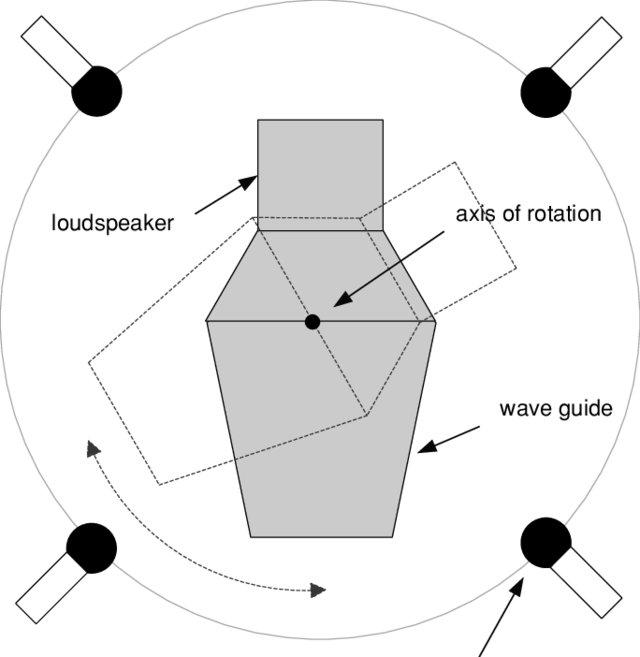
Functional sketch of the Rotationstisch (Braasch, 2008).
The primary effect produced by the Rotationstisch is amplitude panning, achieved through the directivity of the loudspeaker and its waveguide. In addition, the spatialization process introduces a Doppler shift as a result of the loudspeaker’s physical rotation. Because the rotation mechanism can be operated manually, spatial trajectories could be performed in real time and recorded directly onto quadraphonic tape. This technique anticipates later approaches to object-based spatialization by specifying a dynamic angle of incidence for a sound source within the listening space.
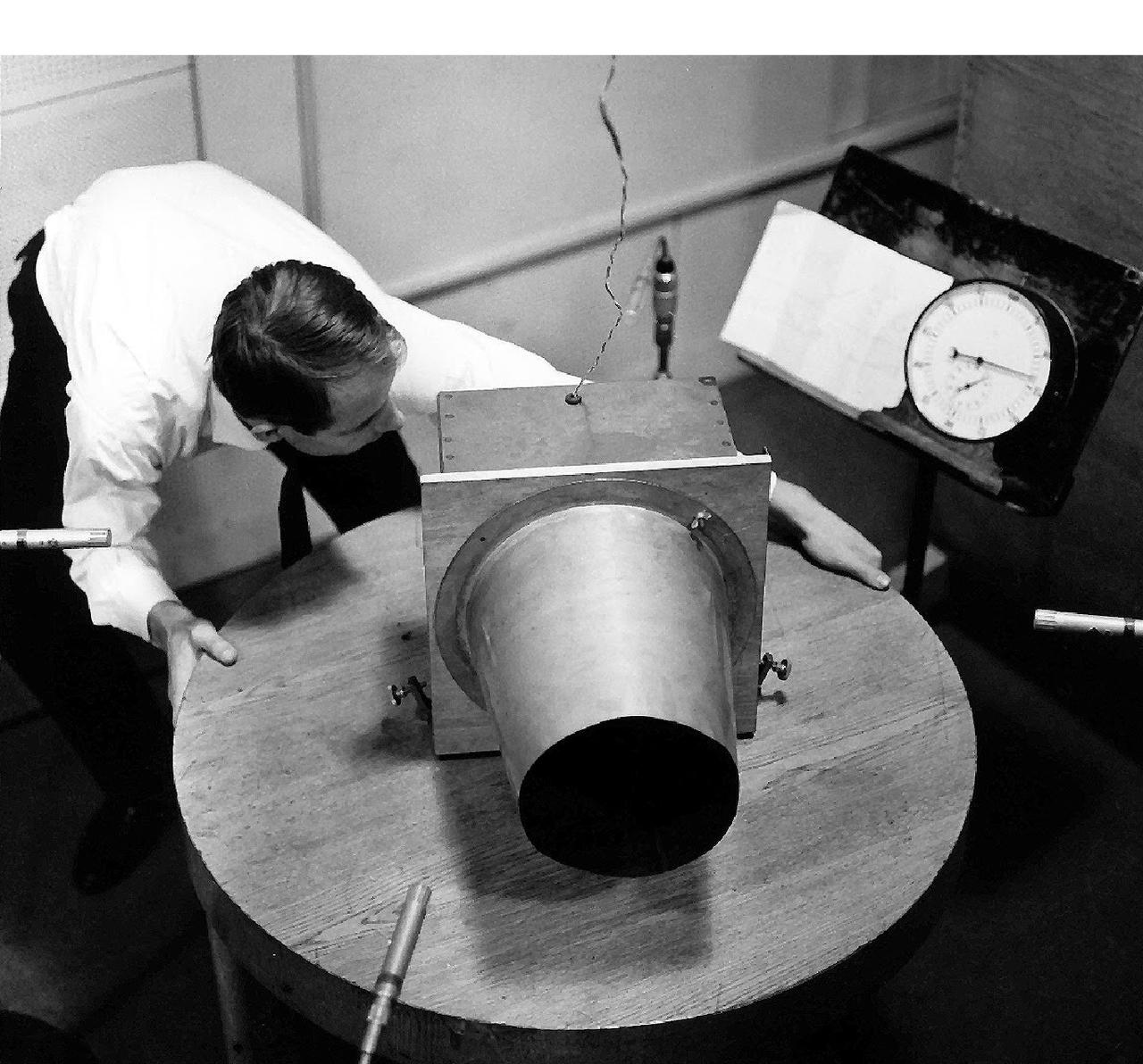
Rotationstisch , operated by Karlheinz Stockhausen (Stockhausen-Stiftung für Musik, Kürten).
References
2018
- Christoph von Blumröder.
Zur bedeutung der elektronik in karlheinz stockhausens œuvre / the significance of electronics in karlheinz stockhausen's work.
Archiv für Musikwissenschaft, 75(3):166–178, 2018.
[abstract▼] [details] [BibTeX▼] - Tomy Brautschek and Maximilian Haberer.
Echoes of pink floyd: experiencing intimacy through acoustic immersion.
Sound Studies, 4(2):234–237, 2018.
[details] [BibTeX▼]
2015
- Martha Brech and Henrik von Coler.
Aspects of space in Luigi Nono's Prometeo and the use of the Halaphon.
In Martha Brech and Ralph Paland, editors, Compositions for Audible Space, Music and Sound Culture, pages 193–204.
transctript, 2015.
[details] [BibTeX▼]
2011
- John Chowning.
Turenas: the realization of a dream.
In Proceedings of the 17th Journées d\rq Informatique Musicale. 2011.
[details] [BibTeX▼]
2010
- Peter Moormann.
Raum-musik als kontaktzone. stockhausens hymnen bei der weltausstellung in osaka 1970.
Paragrana, 19(2):33–43, 2010.
URL: https://doi.org/10.1524/para.2010.0023, doi:doi:10.1524/para.2010.0023.
[details] [BibTeX▼]
2008
- Marco Böhlandt.
“kontakte” – reflexionen naturwissenschaftlich-technischer innovationsprozesse in der frühen elektronischen musik karlheinz stockhausens (1952–1960).
Berichte zur Wissenschaftsgeschichte, 31(3):226–248, 2008.
[details] [BibTeX▼] - Jonas Braasch, Nils Peters, and Daniel Valente.
A loudspeaker-based projection technique for spatial music applications using virtual microphone control.
Computer Music Journal, 32:55–71, 09 2008.
[details] [BibTeX▼]
1980
- François Potard.
L’acousmonium.
In Pierre Schaeffer, editor, La Musique électroacoustique.
INA–GRM / Buchet-Chastel, Paris, 1980.
[details] [BibTeX▼]