
John Cage's Williams Mix
John Cage’s Williams Mix (1952) is an early and influential example of multichannel spatial audio. Cage began working on a channel-based composition for eight loudspeakers, realized using eight single-track tape machines. Because reliable synchronization technology had not yet been developed, the tape machines operated without temporal alignment (Gurevich, 2015).
At a time when tape editing itself was still an emerging practice, Williams Mix became the first realized eight-channel composition. Its production was carried out with the assistance of Louis Barron and Bebe Barron (recording), as well as Earle Brown, Morton Feldman, and David Tudor. The work is based on a 193-page paper score that specifies the tape-splicing procedure in detail, translating abstract compositional decisions into concrete studio actions.
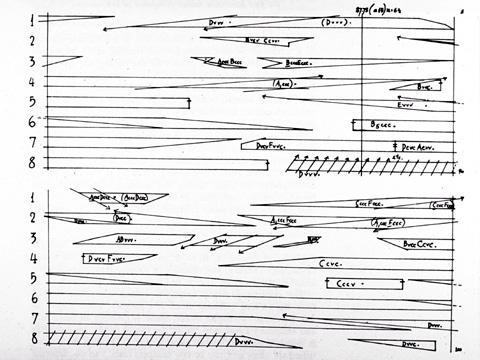
Splicing score for the Williams Mix.
Williams Mix can be regarded as a turning point in the history of electronic and experimental music. Core musical parameters—such as sample selection, channel assignment, and duration—are determined through chance operations rather than compositional intention. Drawing on a wide range of predominantly noise-based sound materials, this process produces a dense, non-hierarchical sound texture that inhabits the loudspeaker system as a spatial environment rather than unfolding as a linear musical form. The work is conceived as a strictly channel-based composition, in which independent tape channels generate continuously shifting spatial textures.
Stereo Version
Although this stereo version does not capture the full spatial experience, it conveys the granular nature of the piece:
References
2015
- Michael Gurevich.
Interacting with Cage: realising classic electronic works with contemporary technologies.
Organised Sound, 20:290–299, 12 2015.
doi:10.1017/S1355771815000217.
[details] [BibTeX▼]
1990
- Richard Kostelanetz.
John cage as a hörspielmacher.
Journal of Musicology, pages 291–299, 1990.
[details] [BibTeX▼]