
Xenakis & Persepolis
Iannis Xenakis (1922–2001) occupies a distinct position in the history of electroacoustic and spatial music. His background in architecture and engineering informs a compositional approach in which sound is treated as a material phenomenon operating at architectural and environmental scale. Rather than developing fixed loudspeaker layouts or spatial encoding systems, Xenakis’ work foregrounds density, duration, sound pressure, and the interaction between sound and physical space. Xenakis’ work is included as an early example of spatial composition in which sound, space, and architecture are treated as a single system. Its relevance lies in the conceptual use of space, rather than in the establishment of a reproducible multichannel technique.
Persepolis (1971)
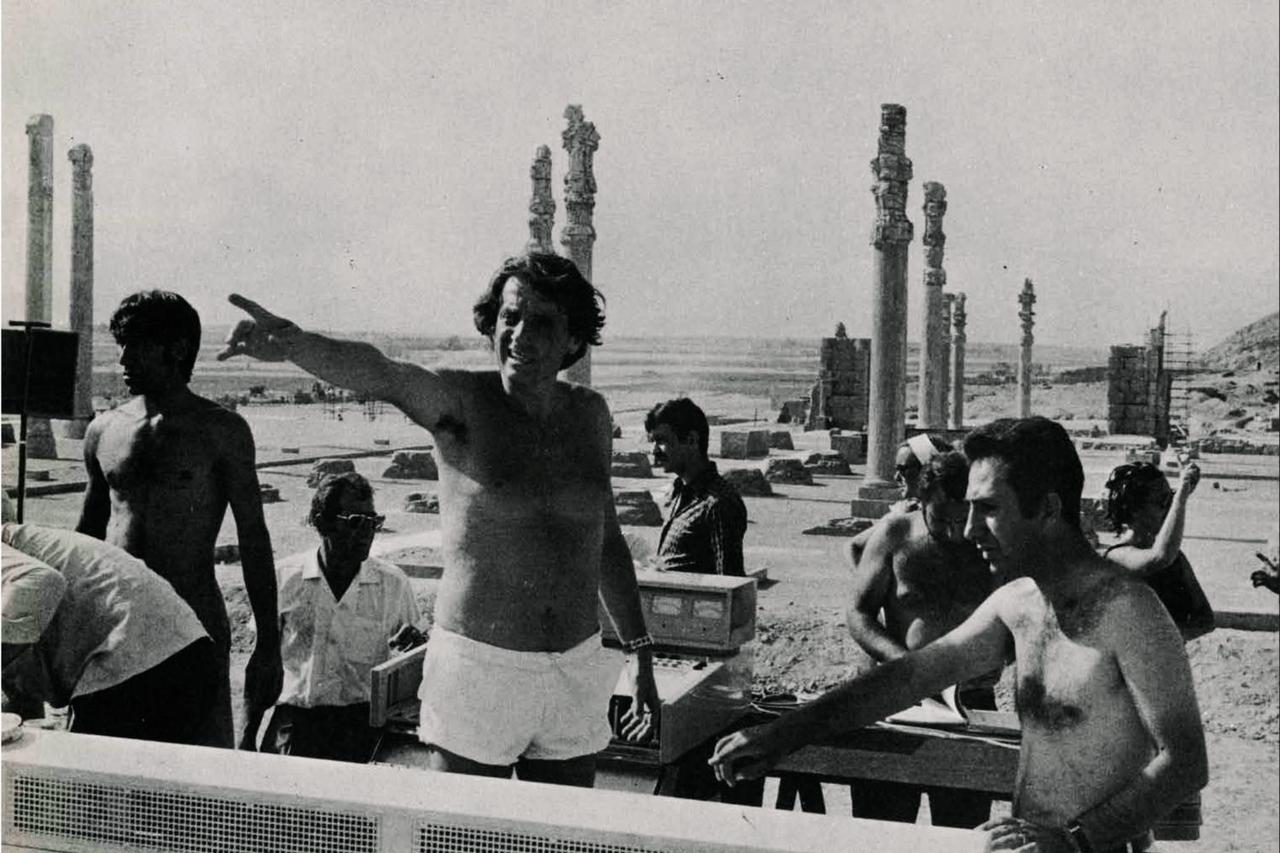
Persepolis represents one of the earliest and most radical realizations of spatial electroacoustic music outside the concert hall. The fixed 8-channel tape was created for an outdoor, site-specific realization. Commissioned for the Shiraz Arts Festival, it was premiered at the ruins of Persepolis, Iran. The loudspeakers were distributed across the archaeological site, treating the terrain and architecture as integral components of the spatial system. The work does not articulate space through trajectories or directional movement, but through sustained sound masses, extreme dynamics, and extended duration.
Spatial Concepts
In Persepolis, spatialization is part of the composition rather than a separate layer. Loudspeakers placed across the site produce overlapping sound fields instead of discrete channels. Spatial relationships follow the physical layout and acoustics of the environment, not encoded movement or panning. Directionality plays a minor role. Spatial perception results primarily from scale, density, and propagation across the site.
Other Relevant Multichannel Works
While Persepolis is the most explicit reference point, several other works by Xenakis are frequently realized in multichannel contexts:
Bohor (1962)
Hibiki-Hana-Ma (1970)
La Légende d’Eer (1978)