
VBAP
VBAP: Vector Base Amplitude Panning
Vector Base Amplitude Panning (VBAP) is a geometric amplitude panning method in which a virtual source direction is expressed as a linear combination of loudspeaker direction vectors (Pulkki, 1997). Only the minimum number of loudspeakers required to span the space are active to create one sound source - referred to as the base:
2 loudspeakers in 2D
Three loudspeakers in 3D.
Algorithm (2D)
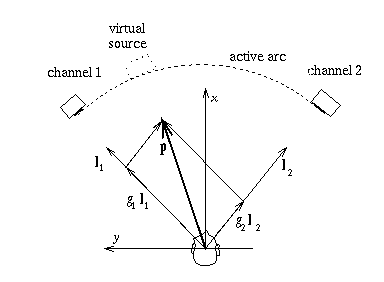
VBAP in two dimensions: a virtual source direction is expressed as a weighted combination of two loudspeaker direction vectors forming an active base (from the original VBAP docs: http://impala.utopia.free.fr/pd/patchs/externals_libs/vbap/vbap.html).
Let two loudspeakers define a panning base with unit direction vectors
and a desired source direction
Form the loudspeaker matrix
The gain vector is obtained by
Energy normalization is applied to preserve constant power (Pulkki, 1997):
Only bases for which \(g_i \ge 0\) are considered valid.
Algorithm (3D)
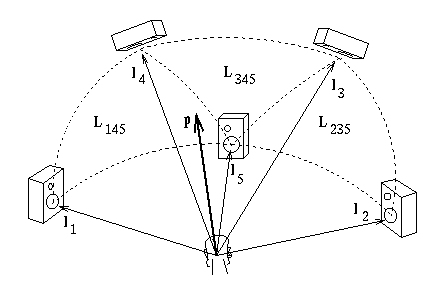
VBAP in three dimensions: loudspeaker triplets tessellate the sphere. One triplet is active at a time, defining a local panning base (from the original VBAP docs: http://impala.utopia.free.fr/pd/patchs/externals_libs/vbap/vbap.html).
In 3D, VBAP operates on loudspeaker triplets that form a tessellation of the unit sphere (Pulkki, 1999). Each loudspeaker direction is represented as a unit vector
For a given triplet \((\mathbf{l}_1,\mathbf{l}_2,\mathbf{l}_3)\):
and the desired source direction
The gain vector is computed as
followed by normalization:
Only triplets yielding non-negative gains are retained.
VBAP Limitations
Convex loudspeaker layouts are assumed (Pulkki, 1997).
Exactly one panning base is active at a time.
Distance is not explicitly modeled.
References
1999
- Ville Pulkki.
Uniform spreading of amplitude panned virtual sources.
In Proceedings of the IEEE Workshop on Applications of Signal Processing to Audio and Acoustics, 187–190. 1999.
[details] [BibTeX▼]
1997
- Ville Pulkki.
Virtual sound source positioning using vector base amplitude panning.
Journal of the Audio Engineering Society, 45(6):456–466, 1997.
[details] [BibTeX▼]